
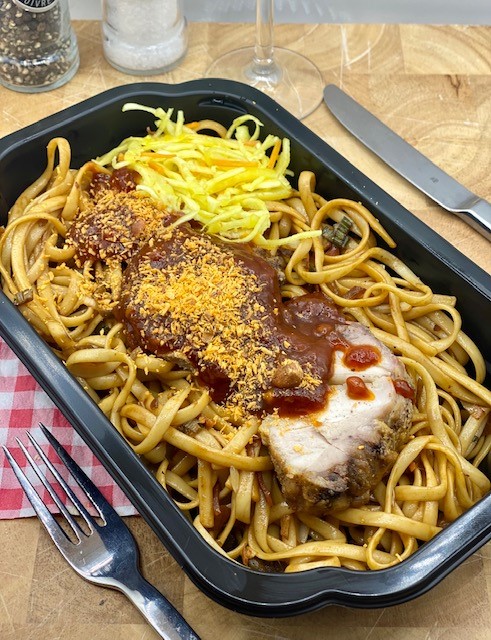
Babi pangang with bami—now that’s a name to be proud of.
Heeft mevrouw Hui-Hui Pan van het Pan Asian Collective wellicht alleen maar een hamer in handen, waardoor zij overal spijkers ziet? (NRC 12/9/26 Een rapport ‘Babi Pangang met bami’ noemen: wanneer de overheid racisme niet herkent)
Het gaat om een draaiboek met titel “Babi pangang met bami” die de arbeidsinspectie heeft gebruikt bij een inval in een Chinees restaurant. De veiligheids- en gezondheidsrisico’s voor de medewerkers in het restaurant noopten tot ingrijpen. Kennelijk heeft die inval tot een rechtszaak geleid, waarbij de rechter de titel van het draaiboek ongepast noemde en de arbeidsinspectie in een verklaring op haar website dat oordeel ondersteunt.
Mevrouw Pan geeft de impact: “een rapport met een dergelijke titel is niet zomaar een flauwe grap, maar past in een veel langere traditie waarin Aziatische mensen worden teruggebracht tot hun keuken, accent, uiterlijk en allerlei stereotypen.” Dat Aziatische mensen discriminatie ervaren is natuurlijk onverteerbaar.
Maar mevrouw Pan (resp. de rechter) zou het ook anders kunnen benaderen. Het Chinees-Indisch restaurant is in 2020 uitgeroepen tot immaterieel Nederlands erfgoed, omdat het representatief is voor de Chinees Indische restaurantcultuur. Kenmerkend daarin is het samenkomen van drie culturen: de Indische, de Chinese en de Nederlandse cultuur. De babi pangang met bami is daar net zo representatief als de gehaktbal met vette jus.
https://www.immaterieelerfgoed.nl/nl/ChineesIndischeRestaurantcultuur
De overheid had het wereldberoemde gerecht niet zomaar mogen gebruiken als titel van haar rapport. Niet omdat er een neerbuigende kwalificatie van de eigenaren en het personeel uit de titel zou spreken, maar omdat het een beschermde titel zou zijn en voor gebruik in theorie dus toestemming zou moeten worden gegeven. Gekheid, wellicht. Maar mevrouw Pan zou ook trots kunnen zijn op de beschermde titel “Babi pangang met bami.
Verder past het in een lange traditie, dat toezichthouders, zoals de FIOD, met spraakmakende en beeldende namen werken voor hun acties. Voorbeelden uit het verleden zijn de actie Baksteen in de bouw en het vastgoed, de actie Schuimkraag bij de horeca over het opsporen van verzwegen bier-/horecaomzet en de actie Goudrand/Goudtand bij tandartsen over het opsporen van verzwegen opbrengsten uit afvalgoud.
Het is een typering van de branche, maar het is daarmee geen neerbuigende typering van de mensen in die branche.
Does Ms. Hui-Hui Pan of the Pan Asian Collective perhaps have nothing but a hammer in her hand, causing her to see nails everywhere? (NRC 12/9/26: Naming a report ‘Babi Pangang with Noodles’: when the government fails to recognize racism)
The issue concerns an operational plan titled “Babi pangang with noodles” used by the Labour Inspectorate during a raid on a Chinese restaurant. Health and safety risks to the restaurant staff necessitated intervention. Apparently, the raid led to a lawsuit in which the judge deemed the plan’s title inappropriate; the Labour Inspectorate has since supported that verdict in a statement on its website.
Ms. Pan describes the impact: “a report with a title like that is not just a lame joke, but fits into a much longer tradition in which Asian people are reduced to their cuisine, accent, appearance, and all manner of stereotypes.” The fact that Asian people experience discrimination is, of course, unacceptable.
However, Ms. Pan (and the judge) could also approach the matter differently. In 2020, the Chinese-Indonesian restaurant was designated as Dutch intangible cultural heritage because it represents Chinese-Indonesian restaurant culture. A defining characteristic of this culture is the convergence of three traditions: Indonesian, Chinese, and Dutch. *Babi pangang* with noodles is just as representative of this culture as a meatball with fatty gravy.
The government should not have simply used this world-famous dish as the title for its report. Not because the title implies a condescending characterization of the owners and staff, but because it is a protected title, meaning—in theory—permission would be required to use it. Perhaps that is absurd. Yet, Ms. Pan could just as well take pride in the protected title “Babi pangang with bami.”
Furthermore, it fits a long-standing tradition for regulators—such as the FIOD—to use high-profile, evocative names for their operations. Past examples include Operation *Baksteen* (Brick) in the construction and real estate sectors; Operation *Schuimkraag* (Beer Head) in the hospitality industry, targeting undeclared beer and hospitality revenue; and Operation *Goudrand/Goudtand* (Gold Rim/Gold Tooth) involving dentists, aimed at uncovering undeclared income from scrap gold.
It characterizes the industry, but that does not make it a derogatory characterization of the people working in that industry.
Ricky Turpijn